
Database Design
Independent table design — existing erupt business tables are unaffected. Tables and menus are created and initialized automatically on startup, with no SQL scripts to run.
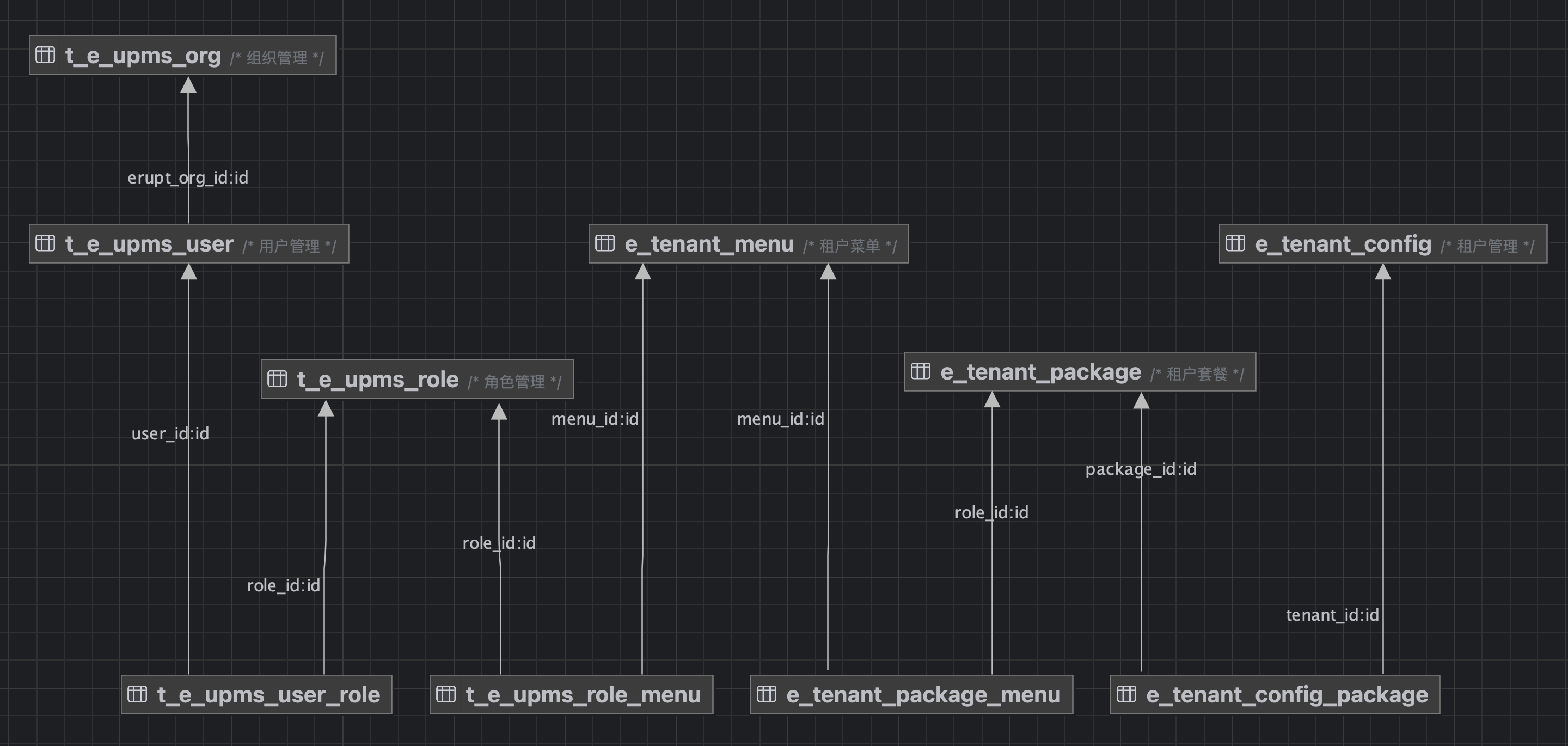
Shared Tenant Tables (maintained on the super-admin side)
| Table | Description |
|---|---|
| e_tenant_config | Tenant config: enterprise ID (unique), tenant name, contact, status, expire date, admin account, domain, logo, tenant CSS / JS |
| e_tenant_config_package | Tenant–package association table |
| e_tenant_menu | Tenant menus: tree structure with unique menu codes; initialized automatically on startup with button-level menus generated per erupt class permissions |
| e_tenant_package | Tenant packages: define a set of menu capabilities granted to tenants per package |
| e_tenant_package_menu | Package–menu association table |
In-tenant Tables (row-level isolation by tenant_id)
| Table | Description |
|---|---|
| t_e_upms_user | Tenant users: unique constraint on tenant_id + account; supports password encryption (MD5 + salt by default), IP whitelist, account expiry, and tenant-admin flag |
| t_e_upms_user_role | User–role association table |
| t_e_upms_role | Tenant roles: unique constraint on tenant_id + code; menu permissions can only be selected from menus in the tenant's active packages |
| t_e_upms_role_menu | Role–menu association table |
| t_e_upms_org | Tenant organizations: tree structure with unique constraint on tenant_id + code |
Business Tables
Business tables annotated with @EruptTenant or extending the TenantBaseModel family automatically carry the tenant field (default tenant_id), with row-level isolation handled by the framework. Creating an index on the tenant field is recommended:
java
@Table(
    name = "t_tenant_demo",
    indexes = @Index(columnList = EruptTenant.TENANT_FIELD)
)
See Multi-tenant Development for isolation behavior details.
Contributors
 YuePeng
 Claude Fable 5.1