
Erupt SaaS Multi-Tenancy
Use Erupt annotation-based low-code development to implement multi-tenancy capabilities. Page functionality is reused across tenants while data is completely isolated. Ideal for SaaS product development scenarios.
Commercial Module
Includes: Full source code · All future version upgrades · Technical support · Priority Erupt-related support · Reasonable feature requests implemented for free · Continuous capability iteration License: No License restrictions · Multi-project reuse allowed · No commercial restrictions Limitation: Redistribution and secondary open-sourcing are prohibited

Officially produced and maintained by the open-source Erupt framework team (GitHub 3k+ ★ · Gitee 5k+ ★). Source code delivered for deep customization with your business.
Demo: https://demo.erupt.xyz/#/passport/tenant
Documentation
Quick Start · Multi-tenant Development · Domain & Tenant Customization · Database Design
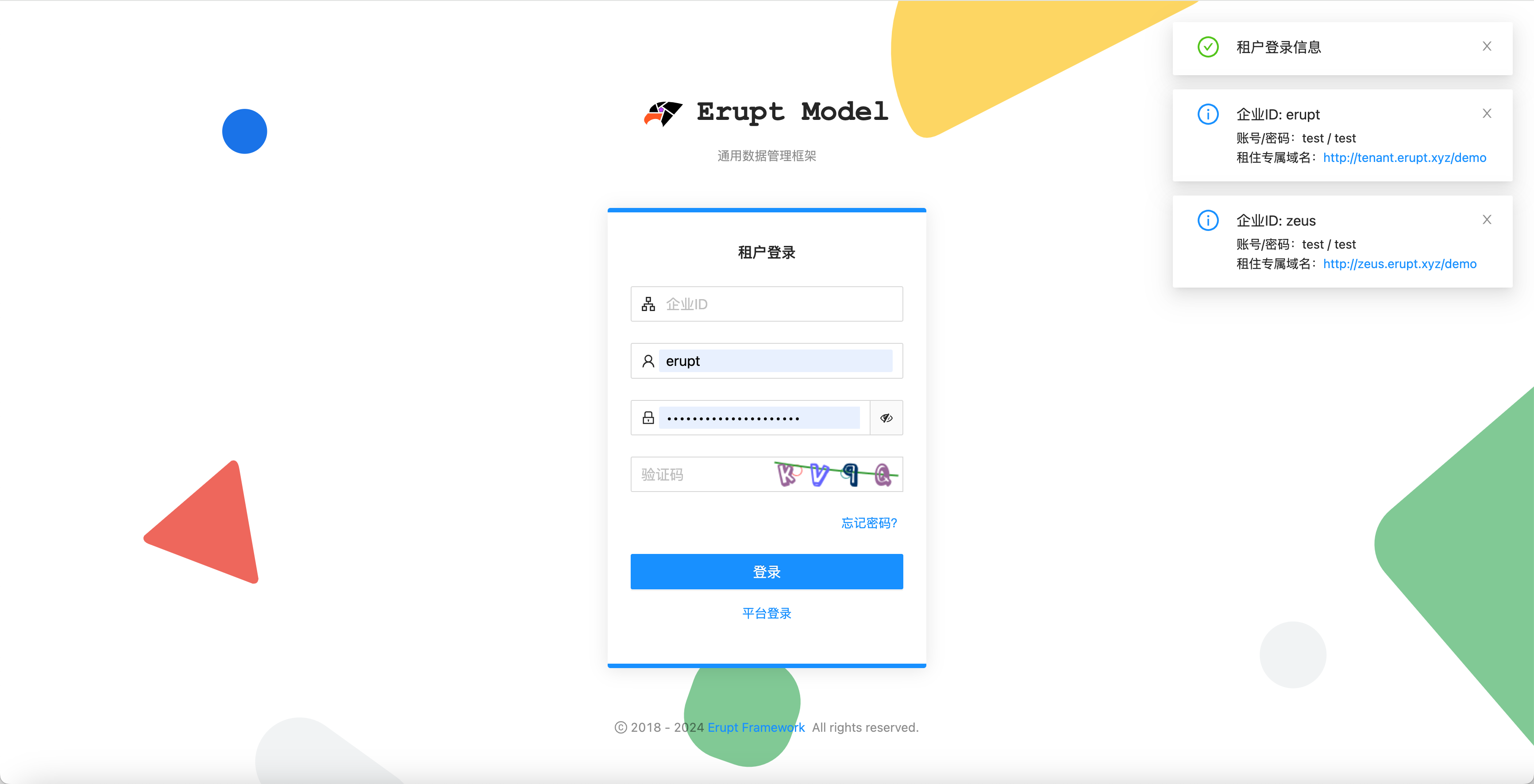
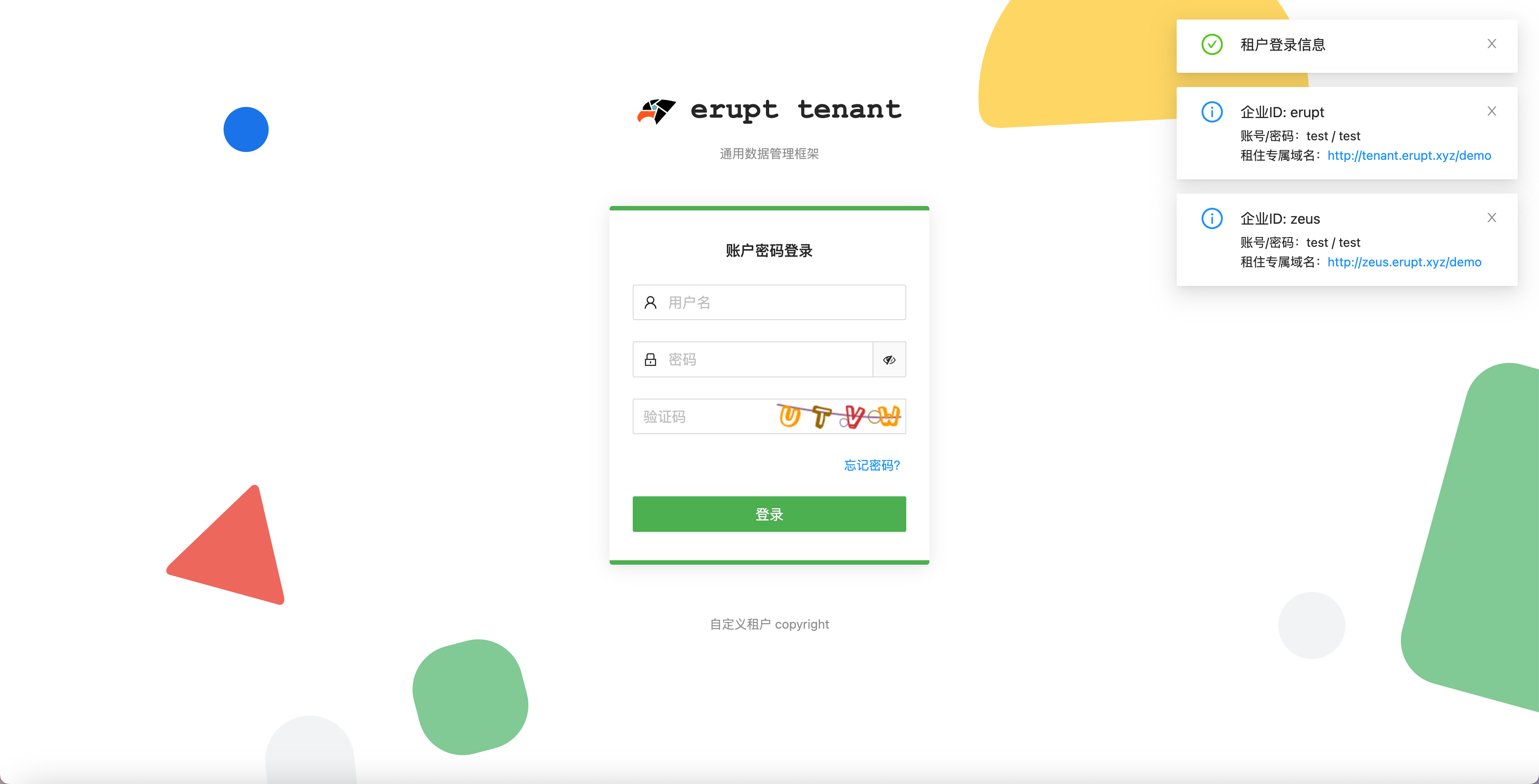
Why Not Use ShardingSphere / Mybatis-Plus tenantId Plugin / Build Your Own?
| Dimension | ShardingSphere | Mybatis-Plus tenantId | Custom | Erupt Tenant |
|---|---|---|---|---|
| Data Isolation | ✅ (database layer strength) | ⚠️ SQL field injection only | Depends on implementation | ✅ Table-level isolation + business-level isolation |
| Business Isolation | ❌ | ❌ | Must be built custom | ✅ Tenant context injected automatically |
| Request Routing | ❌ | ❌ | Must be built custom | ✅ Effective with configuration |
| Per-Tenant Configuration | ❌ | ❌ | Must be built custom | ✅ Independent menus / packages / themes |
| Permission Isolation | ❌ | ❌ | Must be reimplemented | ✅ Reuses UPMS with multi-tenant awareness |
| Learning Curve | Steep | Gentle | — | Gentle (annotations = multi-tenancy) |
| Time to Go Live | 2–4 weeks | 1–2 weeks (business layer still needed) | 1–3 months | 1–2 days |
ShardingSphere addresses the database problem of "how to shard by tenant in the same schema". It does not address the business layer: how does your service know which tenant a request belongs to? How are menus isolated per tenant? How is tenant-specific configuration implemented? All of this must be written manually — this is the most commonly underestimated effort in custom multi-tenancy work. erupt-tenant bundles data isolation + request routing + business context + configuration isolation + permission isolation in one package.
Features
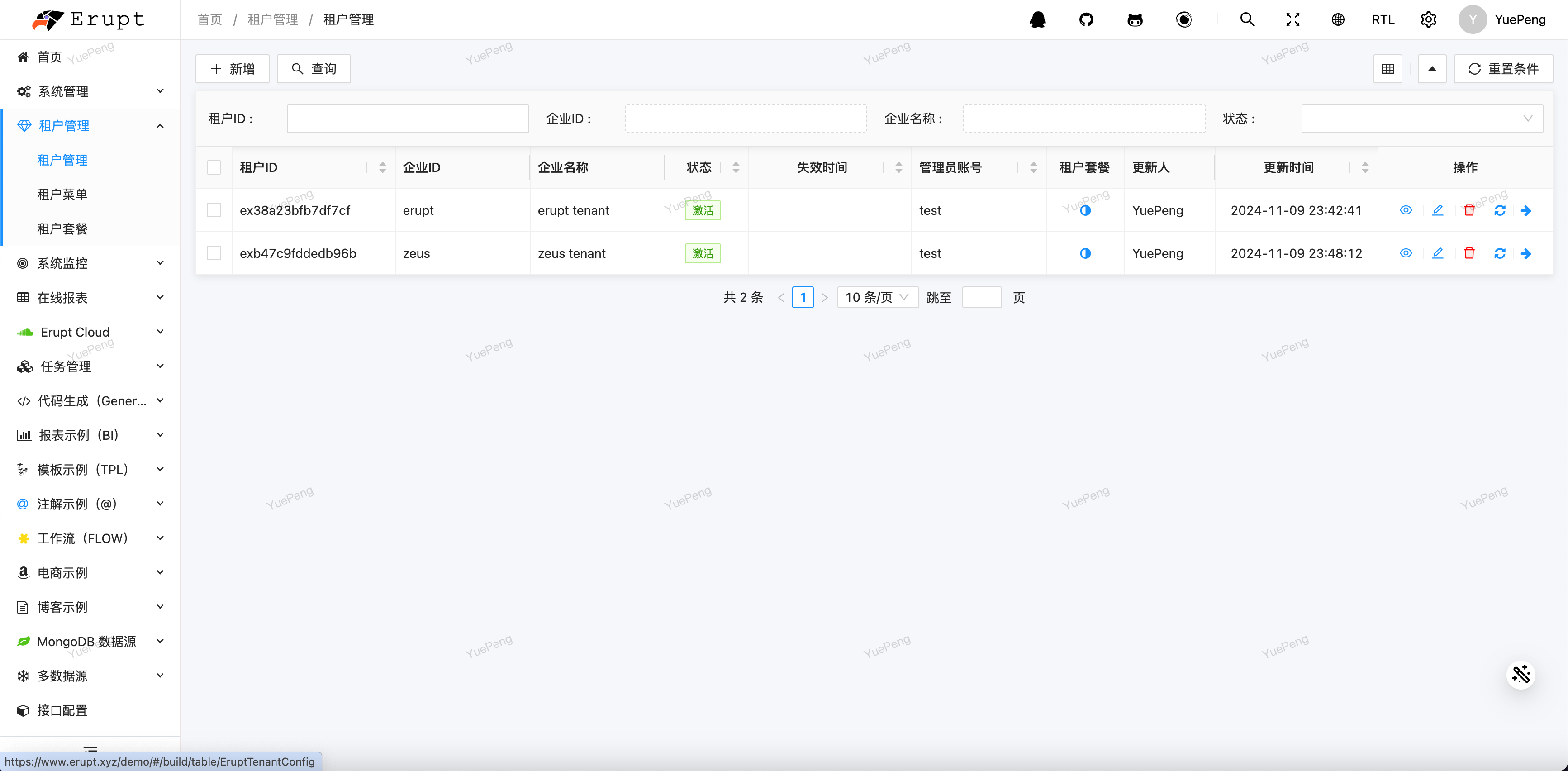
Tenant Management
Manage tenant information via the super-admin account. Supports one-click jump to a tenant application, changing the super-admin password, defining domain names, and tenant-specific JS/CSS:
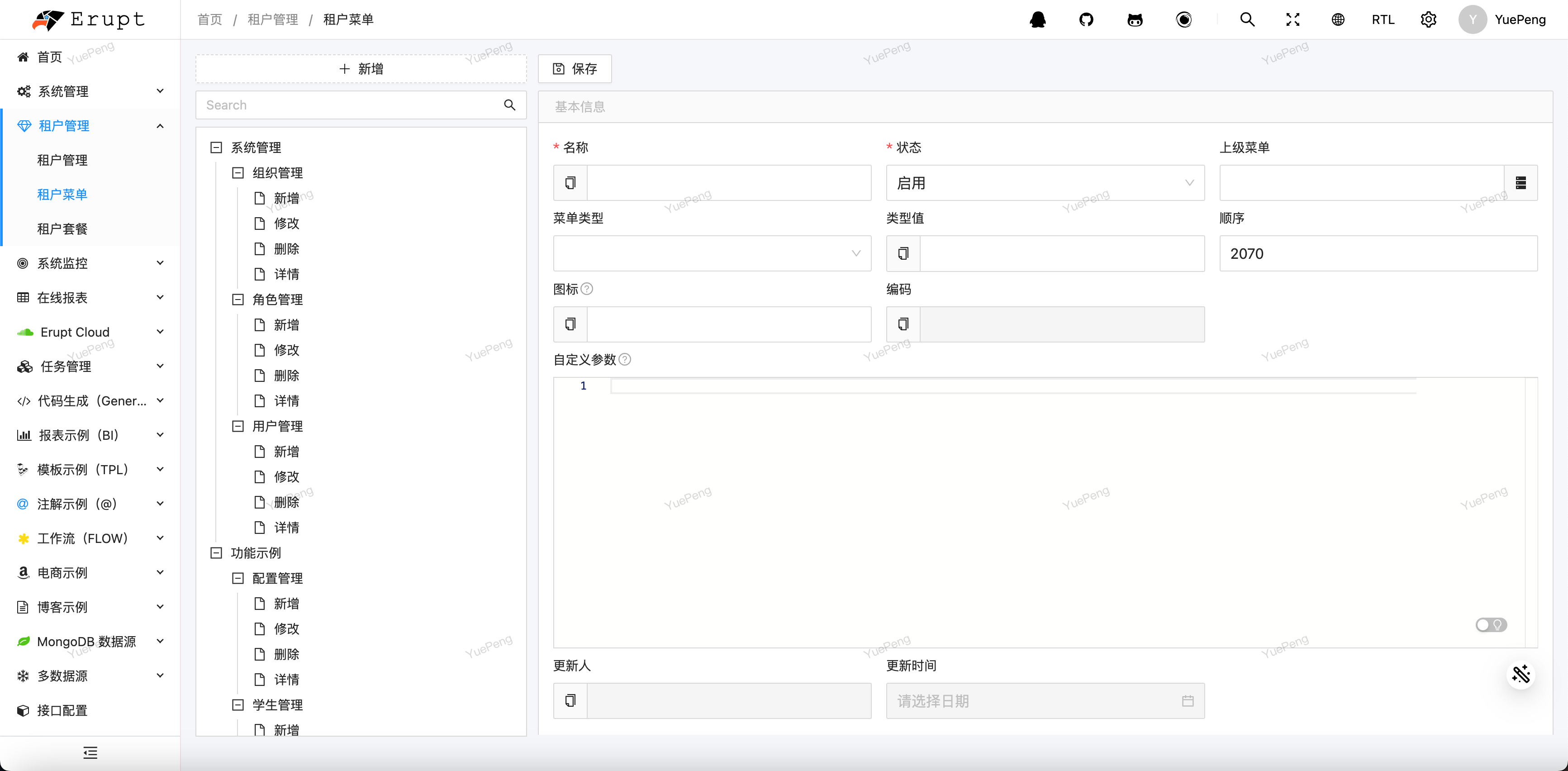
Tenant Menus
Configure the feature menus for each tenant independently. The configuration format is consistent with the Menu Management in system settings:
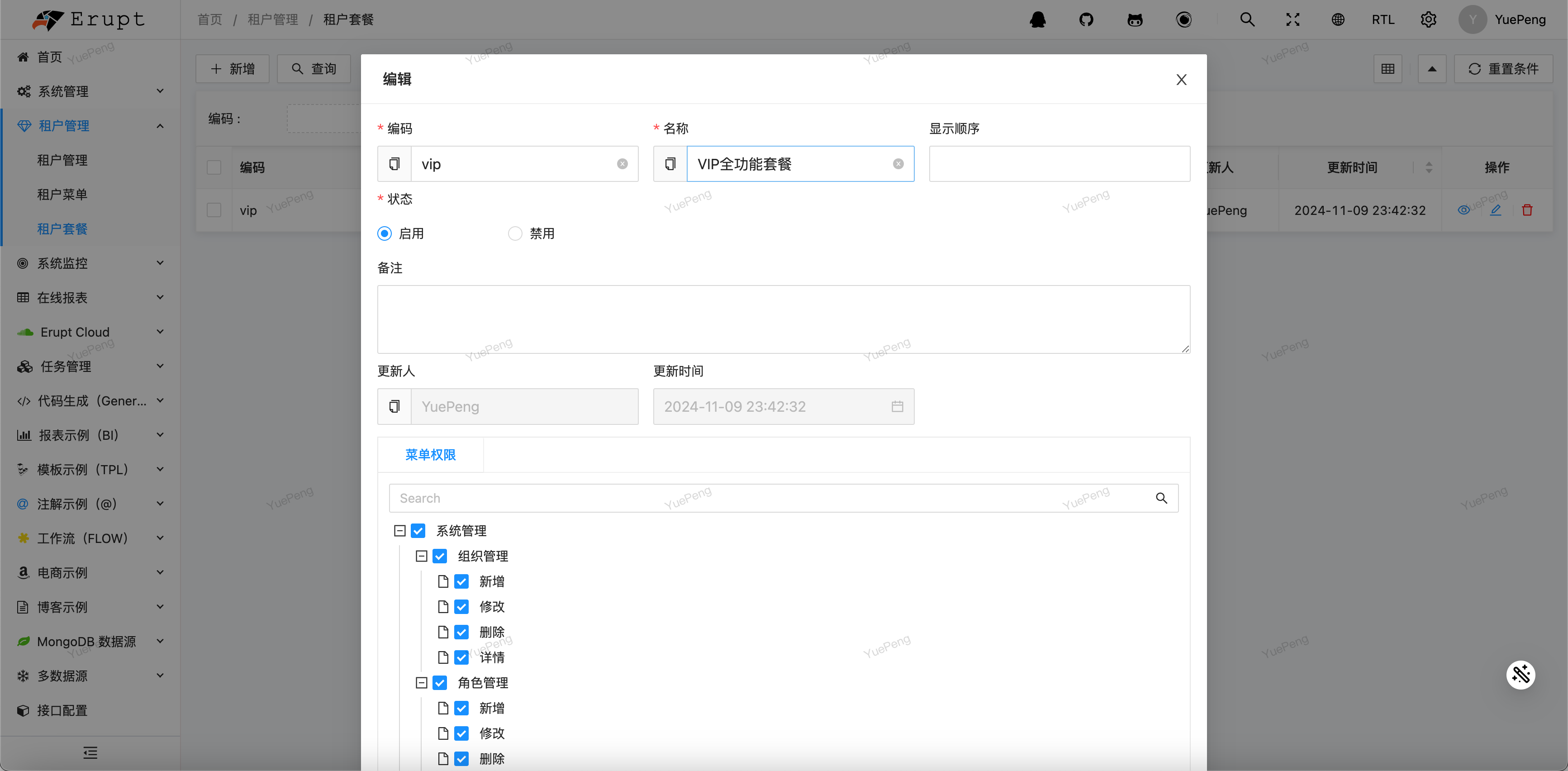
Tenant Packages
Configure which menu capabilities a tenant has. Menu data is completely isolated between different tenants:
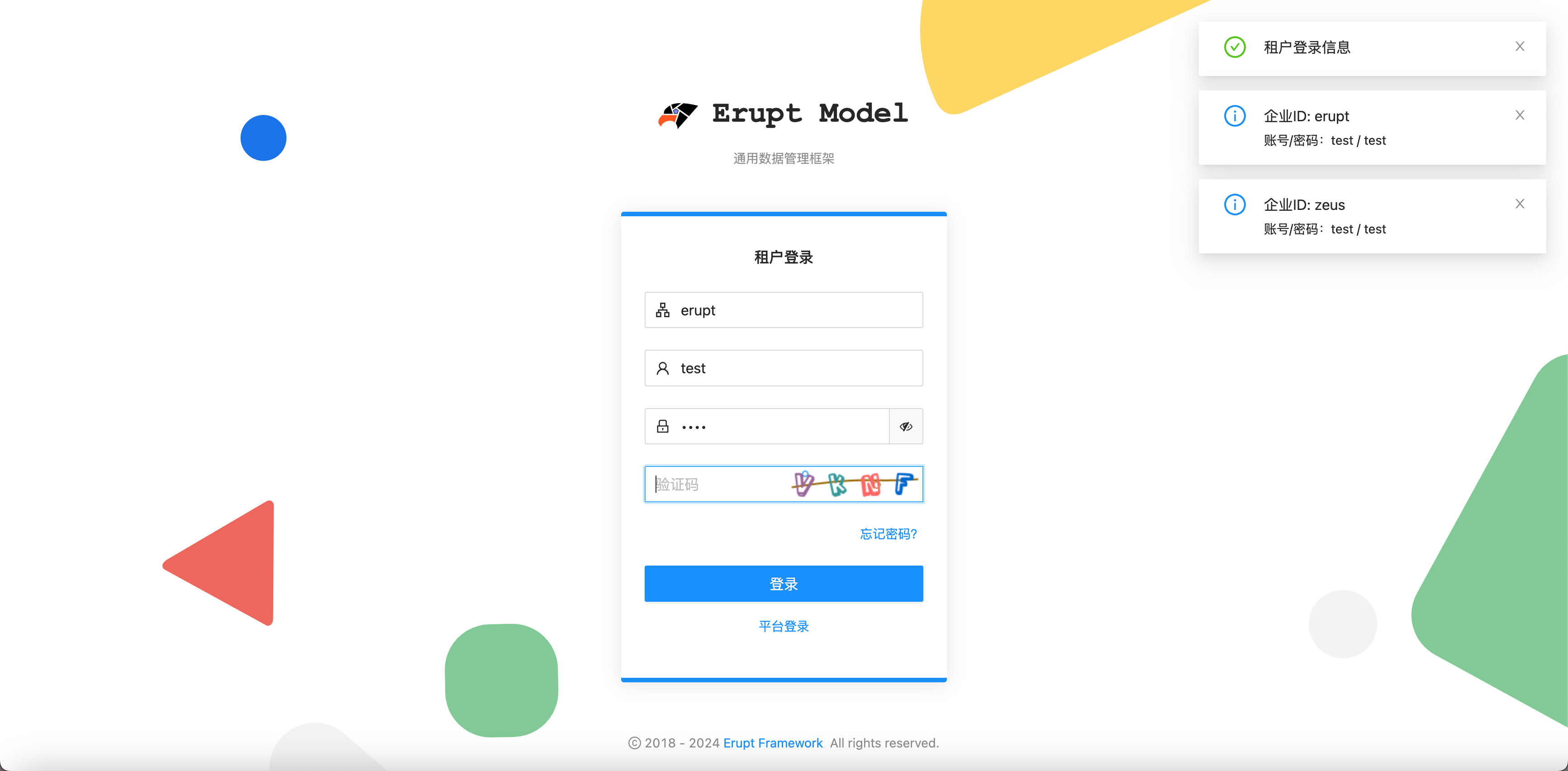
Tenant Login
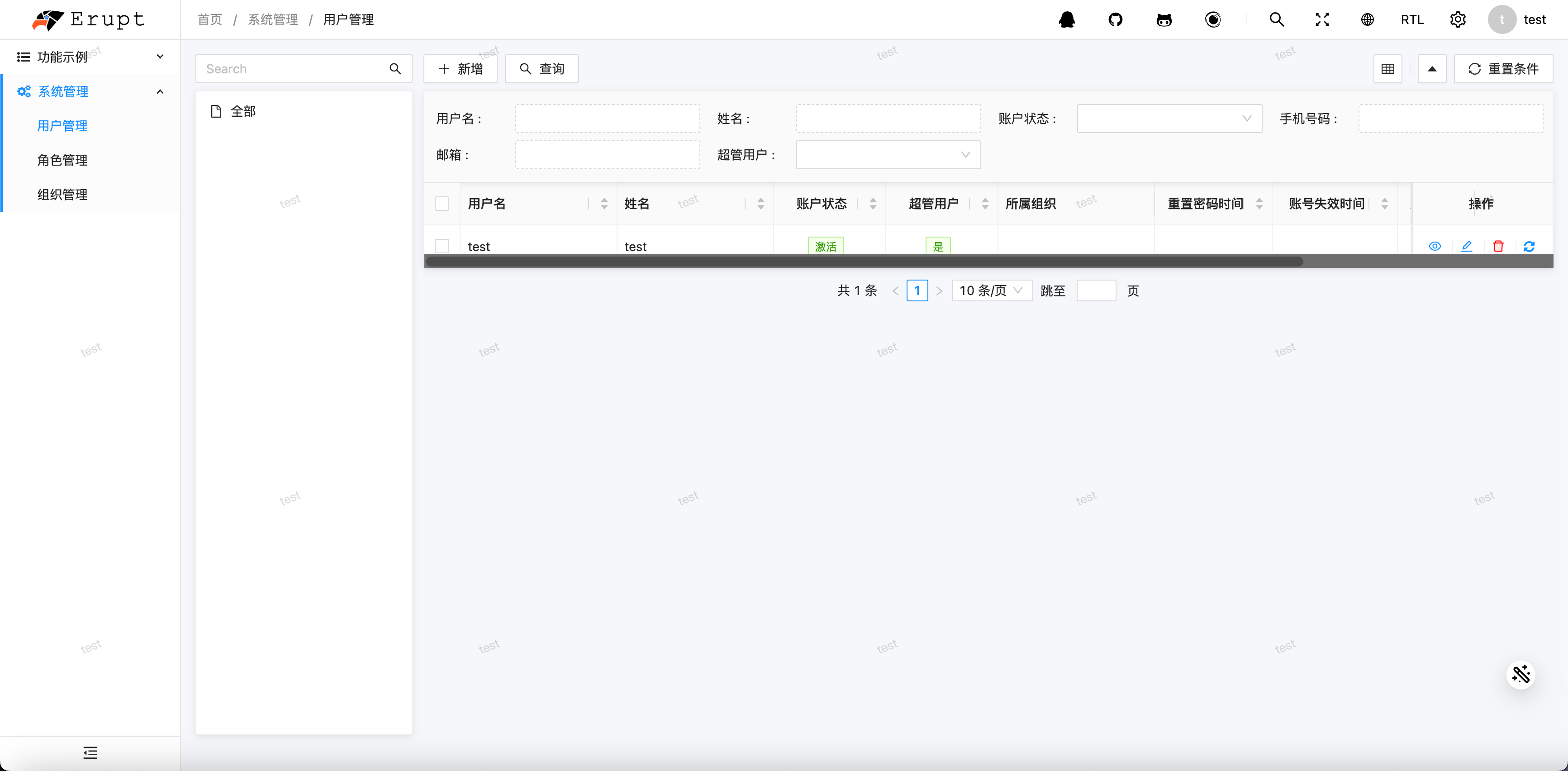
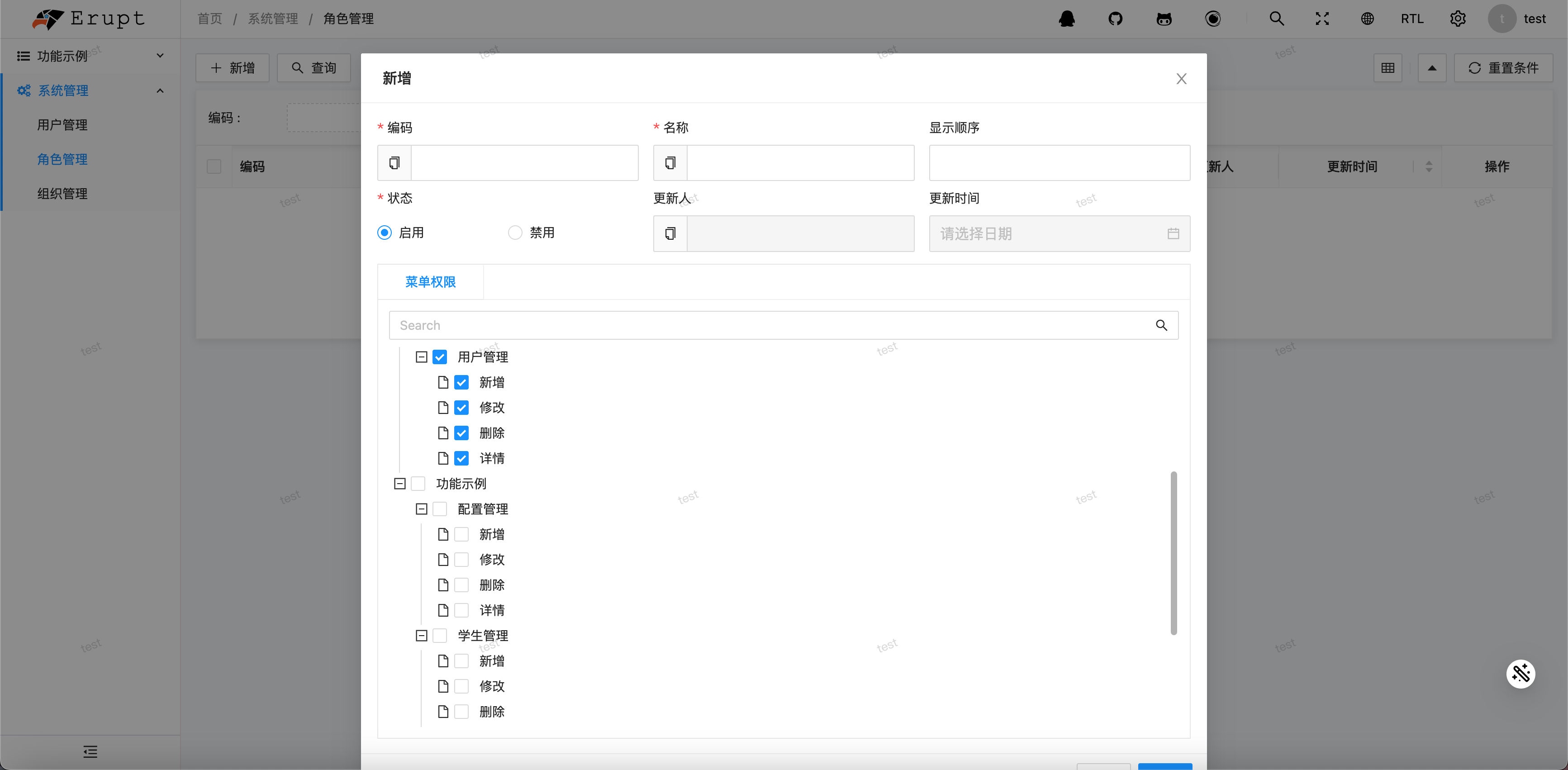
User / Role / Organization Management
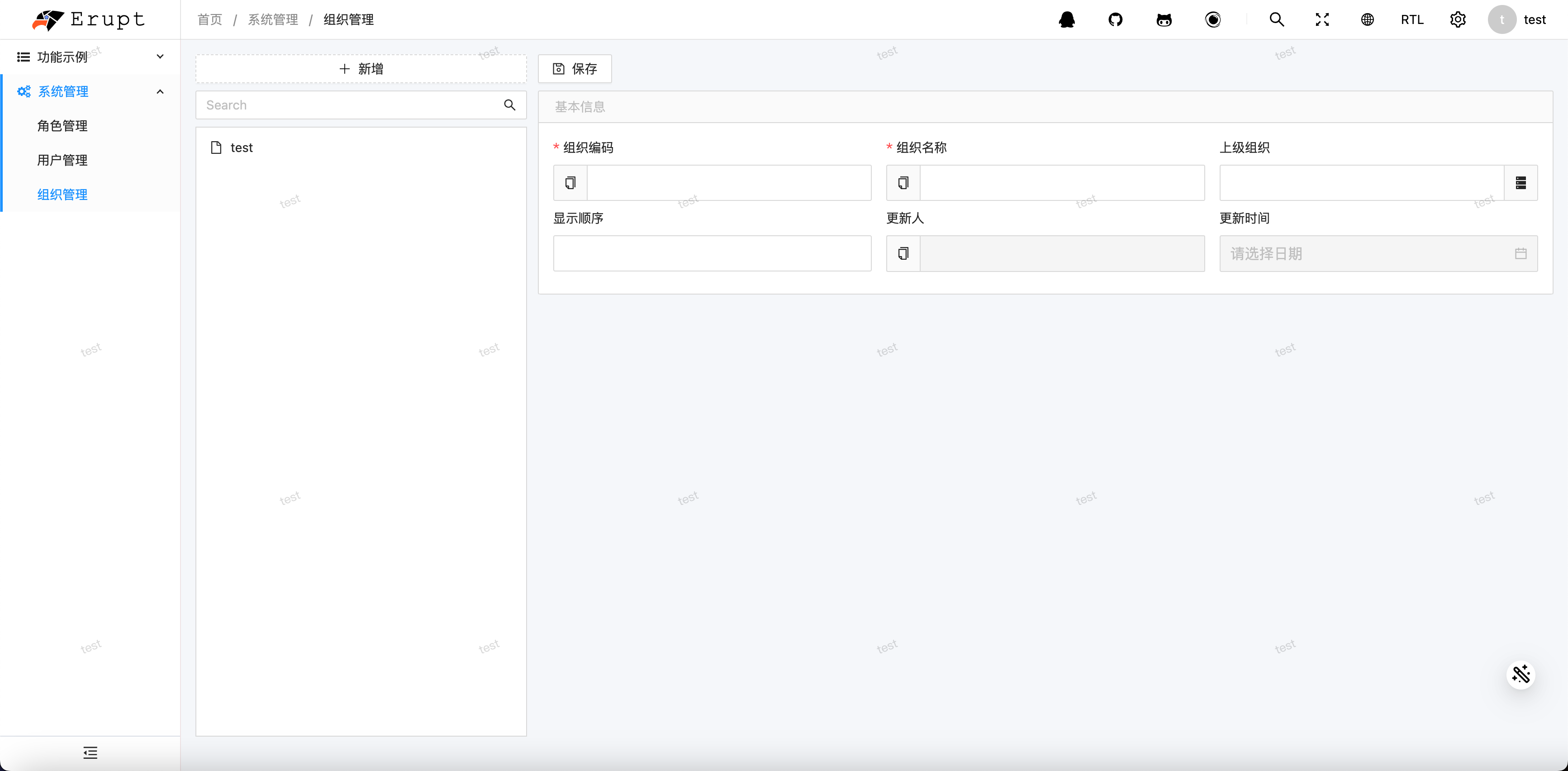
Data Isolation Principle
Uses table-level isolation — all tenant data is stored in the same table, filtered at the row level by tenant identifier, rather than schema or separate database isolation.
Advantages:
- Centralized data storage; queries, backups, and operations require no cross-database work
- Performance optimizations cover all tenant data at once
- No compatibility or upgrade issues with multiple schemas
- No need to allocate separate database resources per tenant; theoretically supports unlimited tenants
Multi-Tenant Development
Add the corresponding annotation to an Erupt class to achieve this: different tenants share the same functionality (which can also be dynamically rendered based on tenant information), with completely isolated data — one codebase serving multiple enterprise customers.
Use Cases
- SaaS startups (one codebase serving N enterprise customers)
- White-label delivery (same system with per-customer branding, domain, and menus)
- Group-wide isolation across multiple departments / subsidiaries
- Multi-region / multi-brand operations
FAQ
Q1 · What is the difference from the open-source Erupt? Open-source Erupt is single-tenant architecture. erupt-tenant is a commercial module that introduces complete multi-tenancy infrastructure (data isolation + request routing + business context + configuration isolation + multi-tenant-aware permissions) — this is not included in the open-source version and will not be open-sourced in the future.
Q2 · How is it delivered? After payment, provide your GitHub username. The author will add you as a collaborator to the private repository erupts/erupt-tenant. You can clone the source code directly, compile locally, reference as needed, and will receive an integration document.
Q3 · Do I need to pay again for future version upgrades? No. One-time purchase = you have access to the current and all future versions. The private repository's master branch is continuously updated; just git pull.
Q4 · What about project count / commercial use / reselling?
- Multi-project reuse allowed: Deploy in as many internal or outsourced projects as you like
- No commercial restrictions: Can be used in commercial products (including selling your finished product, but you may not sell the erupt-tenant source code itself)
- Reselling: Redistribution and secondary open-sourcing are prohibited; company name or entity changes can apply for license migration
Q5 · Trial / Refunds? The online demo has all features available. We recommend fully exploring it first. Once repository access is granted, delivery is considered complete and refunds are no longer supported.
For questions not listed above, visit the pricing & purchase page to contact the author.
Contributors
 YuePeng
 Claude Opus 5 (1M context)