
Custom Home Page (home.html)
Configuration is split into four pages
- Backend configuration (
application.yml):erupt-app,erupt,erupt.upms,erupt.redis-session,erupt.telemetry - Frontend configuration (
app.js): site info, logos, appearance defaults, PWA, router and lifecycle hooks - Frontend styles (
app.css): override or extend the UI styles - Custom home page (
home.html): replace the welcome page shown after login
The welcome page opened after login comes from home.html. It is a standalone static page embedded in the workspace content area as an iframe, so it can be written with any technology and does not depend on Angular.
The default home page
Without any configuration the framework's own home page is used:
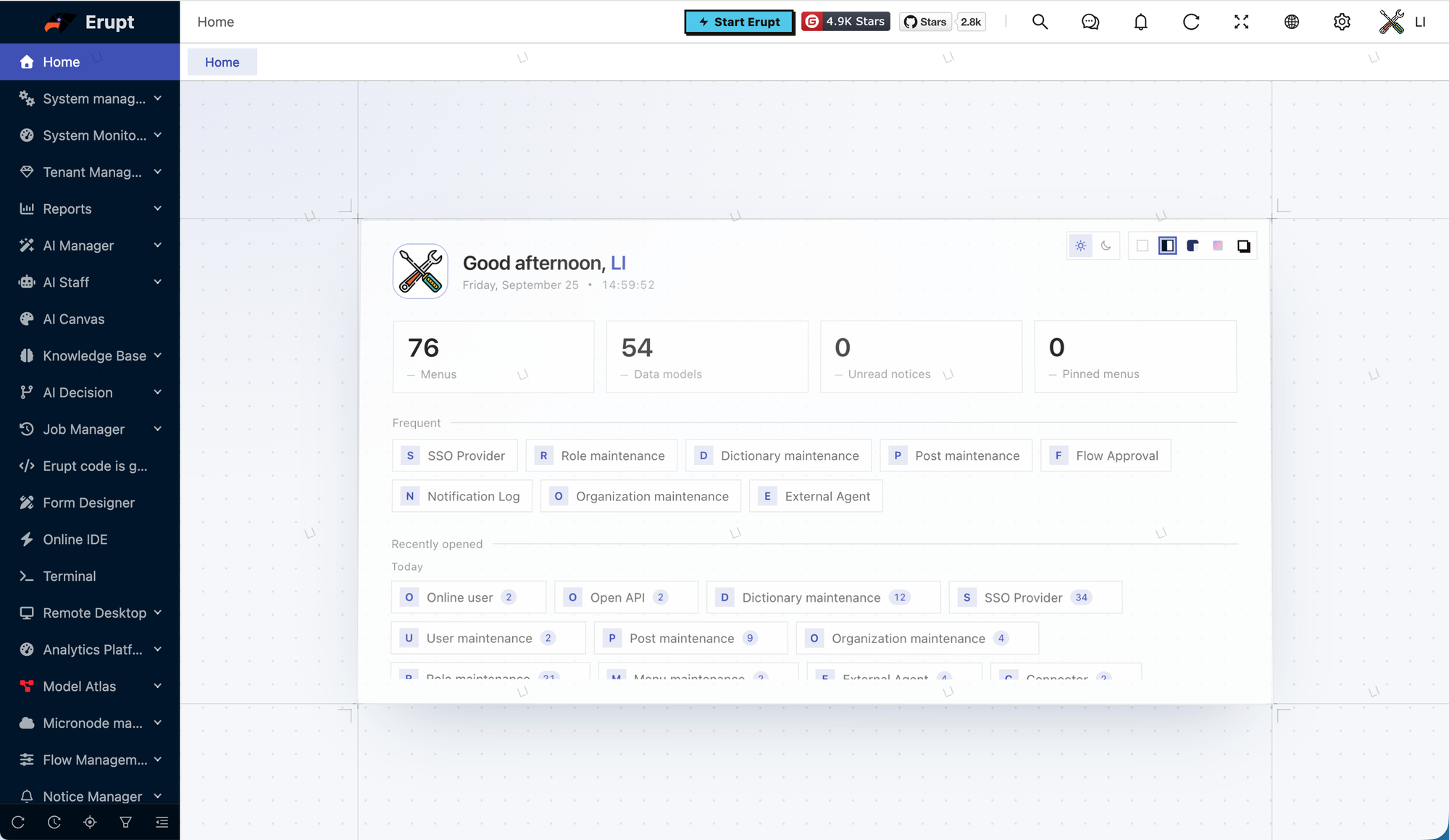
- Greets the current user by time of day and counts reachable menus, data models, unread notices and pinned menus
- Pinned: click the pin on a sidebar item to keep it on the home page; with nothing pinned, the most visited menus are shown instead
- Recently opened: grouped into today / yesterday / earlier, one click to jump back
- The top-right controls switch light / dark and the skin, sharing the saved choices with the settings drawer
Replacing it
Put your own page at /resources/public/home.html in the project. A static resource with the same name overrides the one bundled in erupt-web; nothing else needs configuring:
<!DOCTYPE html>
<html lang="en">
<head>
    <meta charset="UTF-8">
    <meta content="width=device-width, initial-scale=1" name="viewport">
</head>
<body>
    <h1>Hello World</h1>
</body>
</html>
Three sources of the home page
- If the user has a "home menu" set in User Management, that menu opens after login and
home.htmlis not loaded - Otherwise the project's
/resources/public/home.htmlis loaded when present - Otherwise the framework's default home page is used
What the page receives
The workspace loads the page with this URL, from which it can read the session and language:
home.html?v=<build version>&_token=<session token>&_lang=<current language>| Parameter | Description |
|---|---|
_token | The session token; send it in the token header when calling /erupt-api/** |
_lang | The UI language, e.g. zh-CN or en-US; send it in the lang header to get localized texts back |
v | Frontend build version, only for cache busting |
When embedded on the same origin the page can also read the host's eruptSiteConfig through window.parent (for example domain and fileDomain in a split deployment).
var params = new URLSearchParams(location.search);
var token = params.get("_token"), lang = params.get("_lang") || "en-US";
var api = "erupt-api";
try {
    var cfg = window.parent.eruptSiteConfig;
    if (cfg && cfg.domain) api = cfg.domain + "/erupt-api";
} catch (e) { /* cross-origin embed: the host object is unreachable, keep the relative path */ }

fetch(api + "/userinfo", {headers: {token: token, lang: lang}})
    .then(r => r.json())
    .then(user => document.getElementById("hello").textContent = "Hello, " + user.nickname);
The endpoints the default page uses are available to yours as well:
| Endpoint | Purpose |
|---|---|
GET /erupt-api/userinfo | Account, display name and avatar of the current user |
GET /erupt-api/menu | The menu tree the user may reach, handy for rendering your own navigation |
GET /erupt-api/notice/unread-count | Unread notice count (needs erupt-notice) |
GET /erupt-api/erupt-app | Site info, version and enabled modules |
Any other data comes from the erupt data endpoints or your own APIs, with the same permission checks as inside the workspace.
Working with the workspace
Following the theme: the host writes the current color scheme into the iframe's color-scheme, so switching light / dark never leaves a white sheet behind the page. For finer control read the dark class and the --ant-primary-color variable on the host's <html> and watch them with a MutationObserver:
var root = window.parent.document.documentElement;
function syncTheme() {
    document.documentElement.classList.toggle("dark", root.classList.contains("dark"));
    document.documentElement.style.setProperty("--accent",
        getComputedStyle(root).getPropertyValue("--ant-primary-color").trim());
}
syncTheme();
new MutationObserver(syncTheme).observe(root, {attributes: true, attributeFilter: ["class", "style"]});
Jumping to a menu: change the host's hash to open a page inside the workspace; the path follows the menu type:
| Menu type | Path |
|---|---|
| Table / tree / form | #/build/table/<model>, #/build/tree/<model>, #/build/form/<model> |
| TPL custom page | #/tpl/<template> |
| Report / cube | #/bi/<code>, #/cube/<code> |
| Router | #<route> |
window.parent.location.hash = "#/build/table/EruptUser";Switching the skin: the host exposes window.eruptApplySkin(skin) with default / brutalist / liquid-glass / workspace / classic; the default page's skin switcher is built on it.
Notes
_tokentravels in the iframe URL, so the home page must be served from the same origin as the workspace; never host it on a third-party site- In a cross-origin embed
window.parentis unreachable: theme sync and menu jumps are unavailable, only the API calls work - The home page is not kept alive by the multi-tab cache; it reloads every time the user returns, so keep it light
Complete example
A minimal page that reads the user and menus and follows the theme:
<!DOCTYPE html>
<html lang="en">
<head>
    <meta charset="UTF-8">
    <meta content="width=device-width, initial-scale=1" name="viewport">
    <style>
        :root { --accent: #1677ff; --text: rgba(0, 0, 0, .85); }
        html.dark { --text: rgba(255, 255, 255, .88); }
        body { margin: 0; padding: 32px; font-family: -apple-system, "Segoe UI", sans-serif; color: var(--text); }
        h1 { font-weight: 600; }
        h1 b { color: var(--accent); }
        .menus a { display: inline-block; margin: 6px 8px 0 0; padding: 6px 12px; border: 1px solid var(--accent); border-radius: 6px; color: var(--accent); text-decoration: none; }
    </style>
</head>
<body>
<h1>Hello, <b id="name"></b></h1>
<div class="menus" id="menus"></div>
<script>
    var params = new URLSearchParams(location.search);
    var headers = {token: params.get("_token"), lang: params.get("_lang") || "en-US"};
    var root = window.parent.document.documentElement;
    function syncTheme() {
        document.documentElement.classList.toggle("dark", root.classList.contains("dark"));
        document.documentElement.style.setProperty("--accent", getComputedStyle(root).getPropertyValue("--ant-primary-color").trim());
    }
    syncTheme();
    new MutationObserver(syncTheme).observe(root, {attributes: true, attributeFilter: ["class", "style"]});

    fetch("erupt-api/userinfo", {headers: headers}).then(r => r.json())
        .then(u => document.getElementById("name").textContent = u.nickname || u.account);
    fetch("erupt-api/menu", {headers: headers}).then(r => r.json()).then(menus => {
        var box = document.getElementById("menus");
        menus.filter(m => m.type === "table").slice(0, 8).forEach(m => {
            var a = document.createElement("a");
            a.textContent = m.name;
            a.href = "javascript:void(0)";
            a.onclick = () => window.parent.location.hash = "#/build/table/" + m.value;
            box.appendChild(a);
        });
    });
</script>
</body>
</html>
Contributors
 YuePeng
 Claude Fable 5.1